Quick answer: Most Dallas–Fort Worth homes should have attic insulation rated R-38 to R-49. With loose-fill fiberglass, that's roughly 13 to 18 inches of settled depth. Topping up an existing attic with blown-in insulation typically runs $1.25 to $2.75 per square foot, or about $1,900 to $4,100 for a 1,500 sq ft attic (typical DFW estimates as of November 2026). Seal the air leaks first, or you're paying to insulate around holes.
In a North Texas summer, the attic is the hottest room in your house. On a 100-degree afternoon, it can climb far past that, and every inch of missing insulation lets that heat push down into the bedrooms below. If your upstairs never cools off, your AC runs nonstop, or your electric bill jumps every July, the attic is the first place a contractor should look.
Here's how much insulation a DFW home actually needs, how to check what you have, and what it costs to fix.
How much attic insulation does a DFW home need?
Insulation is rated by R-value, a measure of how well it resists heat flow. Higher is better.
The Dallas–Fort Worth area falls in the U.S. Department of Energy's climate zone 3. For that zone, ENERGY STAR recommends:
- R-49 for an attic with little or no insulation
- R-38 when you're adding to an attic that already has 3 to 4 inches
- R-19 under floors over unconditioned space (rare here, since most DFW homes sit on slabs)
The Texas residential energy code requires R-38 in the ceiling for new homes built under the prescriptive path in climate zones 2 and 3. That's the floor, not the goal. Many builder-grade homes from the 1990s and 2000s were finished with R-30 or less, and loose-fill settles over the years.
What that looks like in inches
R-value per inch depends on the material, so always check the depth chart printed on the bag. As a rough guide:
- Blown-in fiberglass: about 13 to 14 inches for R-38, 17 to 18 inches for R-49
- Blown-in cellulose: about 10 to 11 inches for R-38, 13 to 14 inches for R-49
- Fiberglass batts: an R-38 batt is about 12 inches thick
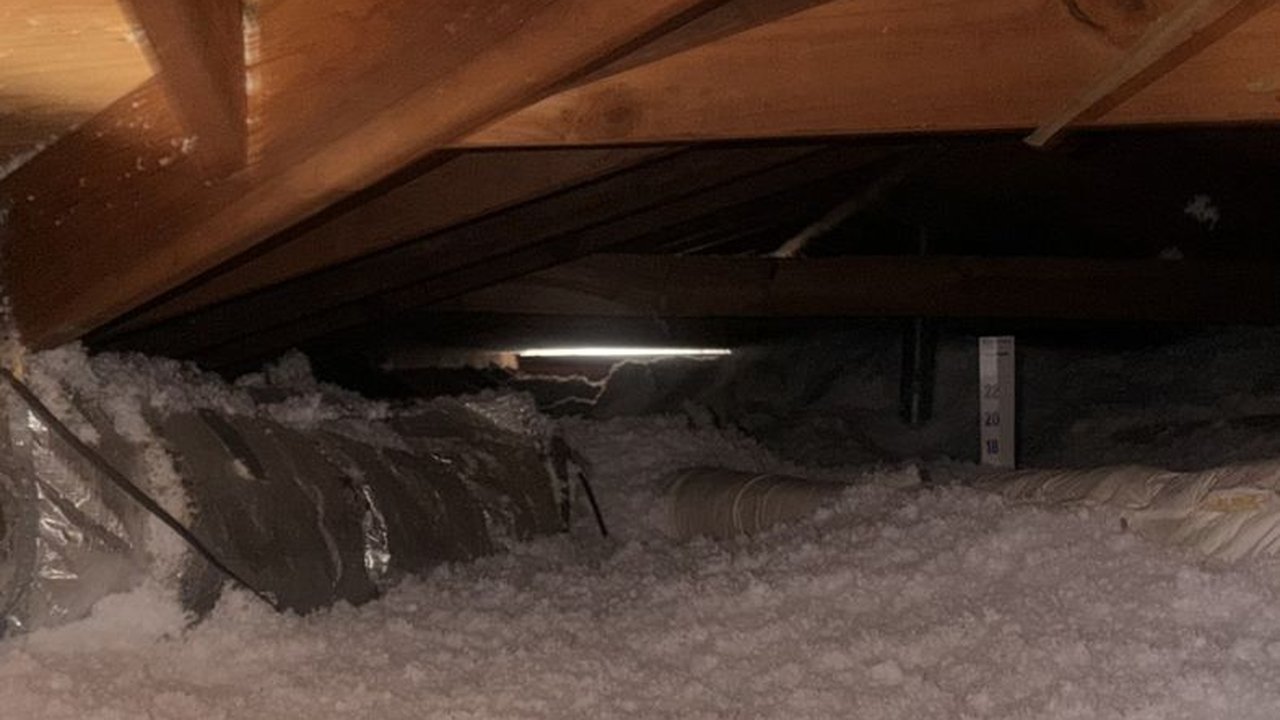
A good installer staples depth rulers to the framing across the attic so you can see the finished depth for yourself. You can spot one in the photo at the top of this article.
How to check what you have
You can get a decent read in five minutes with a flashlight and a tape measure:
- Open the attic hatch or pull-down stairs. Don't step off the framing or decked walkway. Ceiling drywall won't hold your weight.
- Measure the insulation depth in three or four spots, away from the hatch where it's usually been packed down.
- Look for gaps and thin spots, especially along the eaves, around recessed lights, and where HVAC techs have walked through.
- Check the attic access cover itself. An uninsulated hatch or pull-down stair is a big hole in your thermal envelope.
- Look for dark or dirty insulation around ceiling fixtures and top plates. That usually means air is leaking through from the house below.
If you see the tops of the ceiling joists, you almost certainly need more. In a typical 2x6 ceiling frame, visible joists mean you have less than about 5 inches, or roughly R-15 or below.
Why air sealing comes first
Insulation slows heat moving through materials. It does not stop air. Loose-fill fiberglass is a filter, not a wall, so conditioned air leaking up through gaps in the ceiling carries your cooling right out of the house, and dust with it.
Before any insulation goes in, a proper job seals:
- Top plates where interior walls meet the attic
- Plumbing vents, wiring holes, and flue chases (with fire-rated materials where required)
- Gaps around recessed lights and bath fans
- The attic hatch or pull-down stair, with weatherstripping and an insulated cover
This is the same order of work we follow on energy-efficiency upgrades for city housing programs: seal the attic floor, insulate the access, check the ductwork, then bring the insulation up to depth. It's usually the cheapest part of the job and one of the most effective.
What attic insulation costs in DFW
These are typical DFW estimates as of November 2026, based on published national cost guides and local pricing. Your price depends on attic size, access, current insulation, and how much prep is needed.
| Job | Typical installed cost |
|---|---|
| Blown-in fiberglass, topping up existing | $1.25 to $1.75 per sq ft |
| Blown-in fiberglass, full depth | $1.60 to $2.40 per sq ft |
| Blown-in cellulose, topping up to full depth | $1.55 to $2.75 per sq ft |
| Removing old or damaged insulation | $1.00 to $2.00 per sq ft extra |
| Open-cell spray foam at the roof deck | $3.80 to $4.95 per sq ft |
For a typical 1,500 sq ft attic, that works out to about $1,900 to $4,100 for a blown-in top-up. A 2,000 sq ft attic runs roughly $2,500 to $5,500. If the old insulation is wet, moldy, or contaminated by pests and has to come out first, add roughly $1,500 to $4,000.
What drives the price up or down
- Attic access and pitch. Tight, low attics with lots of ductwork take longer.
- Removal. Vacuuming out old insulation is slow, messy work.
- Air sealing scope. Older homes usually have more leaks to chase.
- Ductwork. Crushed, disconnected, or leaky ducts should be fixed before they get buried.
- Baffles. Vent baffles at the eaves keep new insulation from blocking soffit airflow.
Be cautious of a quote that's far below these ranges. It often means no air sealing, no baffles, or a depth that doesn't hit the target R-value.
Rebates and credits in 2026
Two things homeowners often ask about:
- Oncor's Home Energy Efficiency program pays incentives through approved service providers for insulation, air sealing, and weatherization for homes in Oncor's service area. Oncor reports its 2026 funding is fully used and says to check back in January 2027. The program typically runs February through November.
- The federal 25C tax credit for insulation and air sealing ended after December 31, 2025, under the 2025 federal budget law. Work done in 2026 no longer qualifies.
Utility programs change every year, so check the current terms before you count on a rebate. We'll cover the full rebate picture in an upcoming article.
Is it worth it?
For most DFW homes with less than R-30 in the attic, yes. Attic insulation and air sealing are among the least expensive upgrades that make a noticeable difference in comfort, especially in upstairs rooms. They also take some load off your AC, which matters in a region where it runs most of the year.
Our insulation services cover blown-in attic insulation, air sealing, insulated attic access covers, ductwork repair, and removal of damaged insulation. We've completed this same scope on occupied homes through city housing programs in Denton County, and we work across the metro, including Denton, Plano, Dallas, and Fort Worth.
Planning other projects? Browse more homeowner guides in our articles, including choosing flooring for a North Texas home.
Frequently asked questions
Can I add new insulation on top of old insulation?
Usually, yes. If the existing insulation is dry, clean, and free of pests or mold, new blown-in insulation can go right on top. Wet, moldy, or rodent-contaminated insulation should be removed first.
How long does an attic insulation job take?
Most top-ups on a typical DFW home take one day, including air sealing. Jobs that need old insulation removed or ductwork repaired can take two to three days.
Is blown-in or batt insulation better for an attic?
For most existing attics, blown-in is the better choice. It fills around wiring, ducts, and odd framing without gaps, and it's faster to install over existing insulation. Batts work well in open, easy-to-reach attics but are easy to install poorly.
Sources: ENERGY STAR: Recommended Home Insulation R-Values · North American Insulation Manufacturers Association: Texas Energy Code · PickHVAC: Attic Insulation Cost Guide 2026 · Oncor: Residential Insulation Programs · EnergySage: Expiring Clean Energy Tax Credits